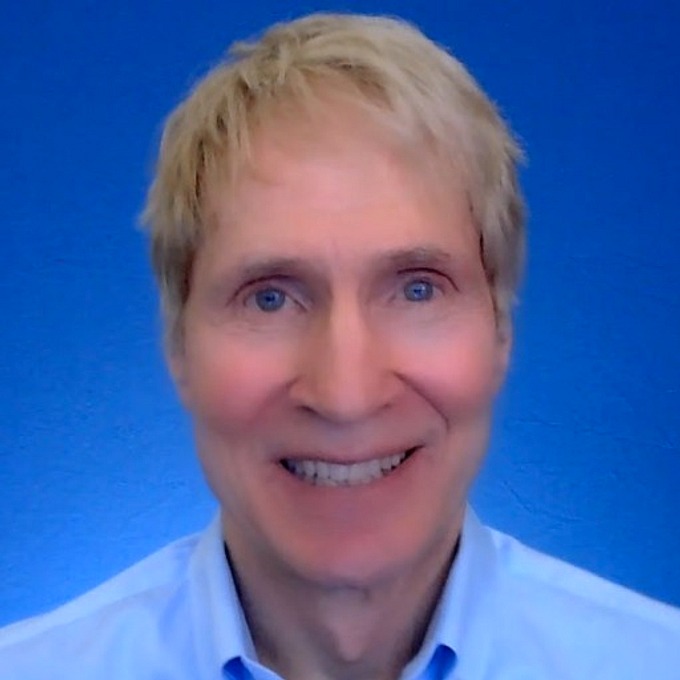
Dr. Larry Farwell's career spans the verifiable and the deeply contested. A Harvard neuroscience PhD raised by a Manhattan Project physicist, he built an early brain-computer interface that let a locked-in patient speak through a synthesizer, invented "brain fingerprinting" for detecting concealed information in the brain, and used machine learning on brainwaves in 1988 — before the field called it AI.
In this episode he moves from that grounded work into his own framework, where consciousness collapses quantum probabilities, "miracles" are simply highly improbable events, and a "quantum bridge" he has filed patents on could feed human intelligence into an LLM's number-crunching core. These are Farwell's claims and views, not established science.
Hosts Roderick Bates and Kelly Sarabyn press him throughout — on mechanism, on evidence, and on who actually benefits — making for a candid, probing conversation about the brain, consciousness, and where AI falls short.
AI computes. AI does not experience. AI does not have consciousness. Now there is a delusional thought out there among people who've been watching too much sci-fi that if you make a system complicated enough somehow it magically becomes conscious. And that's not the case.
Dr. Larry Farwell
Key takeaways
- A first phrase worth building for. Farwell's early brain-computer interface routed EEG signals from a paralyzed, "locked-in" patient to a speech synthesizer, whose first robotic words were "hello mom, how are you?"
- Detecting information, not lies. His "brain fingerprinting" technique looks for an aha-recognition brainwave pattern he calls a MURMER ("murmur"), used in legal cases and counterterrorism, with early studies run with the FBI.
- AI computes but doesn't experience. Farwell argues that no amount of added complexity makes a system conscious, and that the software and hardware behind an LLM are purely computational.
- Strong on facts, weak on wisdom. In his view LLMs predict word sequences from internet text, so they excel at facts and code but falter on judgment, intuition, and moral reasoning.
- Reddit versus the Nobel laureate. He claims an LLM "doesn't distinguish between a bombastic fourteen-year-old on Reddit and a Nobel Prize winner" when answering questions of human intelligence.
- Consciousness as the observer. In Farwell's framework, consciousness is what collapses quantum probabilities, and he claims that he and his father shifted the probability distribution of plutonium's alpha-particle emission by setting up a resonance on the level of consciousness.
- A patent-pending "quantum bridge" into AI. He describes patent applications for feeding an orderly, consciousness-derived stream of numbers into an LLM's hidden states to align its output with human values.
From locked-in patients to brain fingerprinting
Farwell traces his path from a teenage fascination with consciousness and Plato's Republic to a Harvard PhD in neuroscience. As a graduate student he encountered patients who were "paralyzed from the eyeballs down" — awake but unable to move — one of whom had communicated for years only by blinking as his mother recited the alphabet. Farwell built a system to route EEG brain signals to a computer and a speech synthesizer, and the first phrase it produced was "hello mom, how are you?"
He also developed "brain fingerprinting," which detects concealed information stored in the brain rather than detecting lies. By presenting details only a perpetrator — or, in early FBI studies, a trained agent — would recognize, he looks for an aha-recognition pattern in the brainwaves he calls a MURMER, his term for a "memory and encoding related multifaceted electroencephalographic response" (pronounced "murmur"). "We don't detect lies, we detect information," he says. "It doesn't matter whether they lie or tell the truth about it."
So the first sort of robotic sounding voice back at that time that came out of the speech synthesizer was, hello mom, how are you? So my immediate goal was to make one mother happy.
Dr. Larry Farwell
What AI does — and doesn't — do
Farwell offers a pointed critique of how large language models actually work. They parse the internet into tokens, then adjust billions of weights to predict the next word, he explains — so what an LLM does is estimate "the probability of sequences of occurrence of words." That makes it excellent at well-established facts and at writing code, since "by the time something gets out to the internet the code is correct."
But on questions of human judgment, insight, intuition, and moral reasoning, he argues, an LLM returns "an amalgamation of what's out there on the internet." The hosts push back and extend the point, noting that as humans increasingly internalize AI's answers, those averaged-out frameworks could reshape how people think and relate to one another.
It doesn't distinguish between a bombastic fourteen-year-old on Reddit and a Nobel Prize winner.
Dr. Larry Farwell
Consciousness, quantum physics, and "creating miracles"
Here the conversation moves firmly into Farwell's own contested framework. Drawing on quantum mechanics, he claims that "the observer influences the observed" and, going further, that consciousness is what collapses abstract probability distributions into definite physical states. He recounts an experiment with his physicist father in which, he claims, they shifted the probability distribution of plutonium's alpha-particle emission — specifically the even-versus-odd timing of emission intervals, "to the tune of one part in five thousand" — not through willful intention but by "setting up a resonance on the level of consciousness," with the effect strongest for people of higher consciousness. Asked directly about the mechanism, Farwell says "there is not a mechanism"; he frames the result as evidence that consciousness can "create order in an otherwise random system."
From this he builds the thesis of his book, "Science of Creating Miracles, Neuroscience, Quantum Physics, and Living the Life of Your Dreams," arguing that a miracle is simply a highly improbable event and that anyone, to varying degrees, can influence outcomes by "setting up a resonance on the level of consciousness." His apple example — from a store unexpectedly stocking apples up to, in his account, manifesting one in the palm of your hand — illustrates a spectrum he ties to one's level of consciousness. These are Farwell's claims, not established science.
A miracle is just something highly improbable.
Dr. Larry Farwell
A "quantum bridge" into AI — and the brain
Farwell connects his quantum-consciousness framework directly to AI through what he describes as a "quantum bridge" he has filed patent applications on (three of them, he says, each about a hundred pages long). He claims it can feed a consciousness-derived "orderly stream of numbers" into the hidden states — the forward-pass processing — of an LLM, so that, say, ninety percent of the internal (hidden-states) computation follows the usual math and ten percent reflects human intelligence and moral reasoning. In his view, the people best at "creating order in an otherwise random process" — those of higher consciousness — would get the most aligned results, potentially steering AI back toward humanity. He notes he has also built an AI clone of himself trained on his own writings, and that the same approach could be applied during training. This quantum-bridge mechanism is Farwell's own proposal, not established science.
On merging brains and machines, Farwell is skeptical of mechanical approaches. With roughly a hundred billion neurons, each "more complex than the most complex supercomputer," he argues that electrodes are too blunt to meaningfully enhance what the brain is designed to do — a view he extends to drugs and psychedelics. When Sarabyn asks whether he can produce an apple on the spot, he good-naturedly admits he has not reached that level: "That's quite a high level."
We create a quantum bridge into the internal hidden states computations of the AI.
Dr. Larry Farwell
About the guest
Dr. Larry Farwell holds a PhD in neuroscience from Harvard. He grew up in a scientific household — his father was a nuclear physicist on the Manhattan Project. As a graduate student he built one of the first brain-computer interfaces, routing EEG signals from a "locked-in" paralyzed patient to a speech synthesizer (its first phrase: "hello mom, how are you?"). He also invented "brain fingerprinting," a technique for detecting concealed information stored in the brain that has been used in legal cases and classified counterterrorism work, with early studies conducted with the FBI; he calls the underlying aha-moment brainwave pattern a MURMER — a "memory and encoding related multifaceted electroencephalographic response," pronounced "murmur." He first applied AI/machine learning to brainwaves in 1988. He is the author of the book "Science of Creating Miracles, Neuroscience, Quantum Physics, and Living the Life of Your Dreams," and has filed patent applications describing a "quantum bridge" that he says could infuse consciousness into an LLM's forward-pass processing. He has also built an AI clone of himself trained on his own writings.
Full conversation, lightly edited for readability.
Roderick Bates0:01
Hello and welcome to the latest episode of Applied Intelligence. I'm your co host, Roderick Bates, and with me is Kelly Sarabyn. Today we are absolutely delighted to bring someone who represents a r really a remarkable evolution of technology from something that perhaps could have benefited enormously from AI when it was first developed, now really being on the forefront of AI and neuroscience. I'd like to welcome Doctor
Larry Farwell. Welcome to the show.
Dr. Larry Farwell0:34
delighted to be here.
Roderick Bates0:36
Excellent. Well thank you so much for agreeing to be here and we're looking forward to a pretty dynamic conversation. You know, there's there's some people you search on the internet and you don't really find anything too interesting. But Doctor Farwell, you when you give a search for you, it's a remarkable career that you have and it really impressive stuff. So I think probably it'd be great for our audience perhaps for you to do a little bit of a recap. where you got started, how you got into it, some of the things that you've done, and where you are today.
Dr. Larry Farwell1:05
All right. Well, I got started at a a very young age being interested in consciousness, in higher states of consciousness and and also in science. My dad was a a physicist, nuclear physicist was actually one of the guys on the Manhattan project who developed the atomic bomb. So I grew up in a very scientific environment and I was very much interested in human beings and consciousness and and how the
how how life works, how the world works, all of the the the bigger questions about where we are in the universe. And I realized if I
Roderick Bates1:44
W how old were you when you were asking the questions about where our place in the universe? It's always good to to put a pin on that.
Dr. Larry Farwell1:53
Well, the the first time I really got into that more deeply was when I was fourteen years old. And I had some experiences that led me to realize there's probably more to life than than most people had been dealing with and that I had previously realized and I s I started to to read about it and and think about it and study about it and learn techniques for developing consciousness.
I read was at that time was Plato's Republic and he really goes very profoundly and deeply into exploration of higher states of consciousness. He does in a a largely a metaphorical way or an allegorical way, so it's not obvious unless you have some experience to tell you, okay, this is more than just a bunch of words and thoughts and philosophies and ideas. It's about experience.
I realized if I wanted to to learn about the essence of life, I would really need to to study the scientifically and I wanted to learn consciousness scientifically, I'd have to study the brain. I'd also have to gain some knowledge of of quantum physics, which fortunately
So I I w went to Harvard, I got my PhD in in neuroscience. And since that time I've been doing research in in neuroscience and some research in collaboration with my dad in quantum physics. And al along the way, I I like I love science for its own sake, I love pure science doing research in the lab, but what I love more than that is figuring something out, like about how the brain works, and then applying that to do something that makes a difference.
Dr. Larry Farwell3:47
The first brain computer interface to communicate using electrical signals directly from the brain to a computer.
Dr. Larry Farwell3:59
But first got involved in AI in nineteen eighty eight, where we used AI to analyze Britain. We didn't even call it AI back then.
Roderick Bates4:07
Yeah, wha what was it called then and and I guess also what was the objective when you developed that brain computer interface? Was it just to see if you could do it or was there a a particular outcome you were trying to achieve even then?
Dr. Larry Farwell4:21
Well, y yeah, I was minding my business in my lab, I was a grad student at time. And a couple of young men got injured, one of in a car accident and the other one by falling off a silo. And you can injure your brain in such a way that basically the the outputs are taken out while while the internal processing is still intact. So th th these guys were p paralyzed from the eyeballs down.
Only way the but we thought they were awake in there. The only way they could communicate. This one guy had been there in that state for twelve years. His mother had been taken care of. And the only way he could communicate was she would go through the alphabet and he would blink his eyes when she got to the letter that he wanted to communicate so he could put together words and Yeah. So I developed I thought, well shoot, w we're getting we're getting information out of the brain.
Roderick Bates5:07
That's slow going.
Dr. Larry Farwell5:17
without people using their their mouth or their their hands, or w we we can get brain signals, EEG, electrophysiological activity measured from and unbasedly from the outside of the scalp. I I keep putting my fingers where the electrodes are placed. Exactly. and so so I developed a a system to do that. And we tried it out on this guy who was had been paralyzed for fourteen years, his mom had been taken.
Roderick Bates5:31
Yeah, exactly. Have little cap on, right?
Dr. Larry Farwell5:48
And we would be able to route the signal from the brain to a computer to a the speech synthesizer. And so the first the first sort of robotic sounding voice back back in that at that time that came out of the speech synthesizer was, hello mom, how are you? So for my immediate goal was to make one one mother happy.
Roderick Bates6:09
it's beautiful.
Kelly Sarabyn6:14
And one one man as well. I'm sure he was thrilled not to have to do so many blinking.
Roderick Bates6:15
Yeah, mission accomplished. You mentioned using
Dr. Larry Farwell6:21
Yeah it He was. It gave them access to the outside world.
Roderick Bates6:28
And you mentioned using AI in that c or the machine learning in that context. You know, what did that look like and and how was it applied and and developed?
Dr. Larry Farwell6:36
Well, actually I I I was using AI in another invention that I had at the same time. and it was called brain fingerprinting and it's it's technique for detecting concealed information stored in the brain. So I've applied it a lot in well, in some some legal cases, like w we freed an innocent man who hadn't committed the murder he was
Of and put a serial killer away, and I've used it a lot in classified counterterrorism operations in the Middle East. because you can tell the the not only the perpetrators who usually don't survive the incident, but the planners of a major terrorist act have that information stored in their brain, and we can detect that. So
You you present like one of the first studies I did was with the FBI, where we would present on a computer screen information that only an FBI agent would recognize through their unique training, and and we'd mix that in with other things. And the FBI agents, they would have an aha experience when they saw that FBI relevant information. Similarly, a a a a perpetrator of a a crime.
is going to know the details that nobody else knows and you can detect that. So the the way I was using AI was to distinguish between different categories of brainwinds to to learn what certain brain responses look like and to and to then to see if that same response was occurring or a different
Roderick Bates8:09
And there's cons enough consistency from person to person then with that methodology. Like the way that my brain responds is the same as as someone else's.
Dr. Larry Farwell8:19
Well, i there is considerable consistency, but we were also doing it training it on a particular individual as well. So you you get more precise results with the individual and yet there are some common patterns. There's one there's one specific pattern in the brain waves. When your brain engages in certain tasks, you get a particular style of functioning, a particular pattern of functioning in the brain waves. And when you have an aha experience
you get a pattern in the brainwaves which is called a memory and encoding related multifaceted electroncephographic response, or M-U-R-M-E-R murmur. And these murmur moments are we can use for detecting information, we can use for communication. And also they have an evolutionary value. They have a that's how the brain learns and evolves. Say you're you're two years old
And you're crawling around on the floor. So you touch the floor, you touch the wall, you touch the table leg, not much happens. You you there's no real new useful information. If you touch the hot stove, you have an aha experience. okay, now there's something important that has to r be integrated into my understanding of how of my view, my vision, my internal representation of the world. And so
These aha experiences open up our brain for reprogramming. And that we can take advantage of in in
Dr. Larry Farwell9:57
towards more successful styles of functioning. And that's something that I'll get into a little bit later when we start talking about developing your higher levels of consciousness.
Kelly Sarabyn10:09
So the AI was helping to find the pattern in the first place, or on the individual level, or both?
Dr. Larry Farwell10:10
So we don't know.
Dr. Larry Farwell10:16
Both to find the pattern and then we have statistical methods to apply the pattern to see is we found the pattern now we'll get what is is this pattern here? Is it if we have the pattern that looks like somebody recognizes this information, or we look at the pattern that that's looks like that's irrelevant information to them. You you have a murmur moment or you or you don't. And here you go.
Roderick Bates10:37
How do you go from there to actionable intelligence? I'm c I'm curious about the process. You know, you mentioned say like catching a serial killer. I mean, th that's obviously pretty exciting. How does one go from okay, they r they clearly recognize this, but obviously the person's gonna lie, right? So but this is operating on a level sort of behind the lie, but how do you use this or how is this used to sort of a sort of open the can, if you will, and and get to the truth with individuals?
Dr. Larry Farwell10:57
Sure.
Dr. Larry Farwell11:06
Alright, well, let's say you have a murder suspect, and of course I've done with this with murder suspects. And the first thing you have to do is find out what they what they know from some other way other than committing the crime. Because we can detect what information is stored in the brain. So we need to know what information they have that would be would not be an indication they were
Present at the crime scene. So we interview the information, the individuals, and find out what what they know. I mean, they read something in the newspaper, they know that. They've been to a trial, they'll know what happened at the trial and so on. But in any case, there are a lot of details that are known only to the perpetrator and to investigators.
So we take these details. For example, let's say we talk to him, you say, well, I wasn't there, nothing to do with it, I have no idea what happened. I d I d do you know what the the murder weapon was? And he said, No, don't know what the murder weapon was. Okay. Okay, Mr. Suspect, you are gonna see several options here. You're gonna see a knife, a pistol, a rifle, and a baseball bat. Now none of those mean anything particular to you to to you right? no, I don't I don't know which one's a murder weapon. I don't the the they all look the same to me.
And so then you present those items, and if he knows which one is a murder weapon, he's going to have that aha experience. And we pick up that pattern. We say, okay, that information is stored in the brain. We did that with FBI agents. We presented information only an FBI agent would know to their unique training, and they would have these aha experience. So we could we could see who's an an a FBI agent. Similarly, we we can pick up who is a trained terrorist.
You s you know certain things that that they would know that nobody else would know. Somebody would know the internal workings of a terrorist cell, for example, that no one else would know. So w we d we don't detect lies, we detect information. It doesn't matter whether they lie or tell the truth about it, we detect the information.
Roderick Bates13:13
Yeah, it's just awareness or or f I guess familiarity or or recognition.
Dr. Larry Farwell13:20
Yeah, yeah exactly.
Well well go ahead and one more next time.
Roderick Bates13:28
So when you think about where this is going then, I you know, that seems like a a fairly well established technology. You mentioned being used in in counterterrorism, it's being used in court. Is there ways in which that technology is continuing to evolve?
Dr. Larry Farwell13:43
Yeah. And in order to do that I actually have to talk about not just neuroscience but quantum physics. And well
The real world, which is the world of quantum physics and relativity physics, is actually way different than what appears on the surface. And I'll give you an example. I'm gonna geek out for a minute on the structure of the universe there, but bear with me because this will become relevant. So I have in front of me a table. A knock on the table, I think you can probably hear it if you hear it. Yeah.
Roderick Bates14:19
Mm-hmm. Sounds solid.
Dr. Larry Farwell14:21
Sounds solid. It looks very solid. It looks really different from the air around it or my body or this computer in front of me and so on. But if you look more scientifically at it, you look deeper, it's actually not solid at all. It's mostly empty space and you have molecules moving around.
And if you look within the molecules, you see again mostly empty space and atoms. You look within the atoms, you see an extremely high percentage of empty space and elementary particles, protons, neutrons, electrons. You look within those, you'll see quarks. Now, if you go beyond the quarks to the string theory level, you'll simply see patterns of vibrating strings. So this table
is n is simply a different pattern of vibrations than the air around. It's not a different object. It's a it's just a different pattern of vibrations. It's not different separate from my body or the air around it or the ocean out there or the the trees out there. I'm on I'm on a boat by the way, you might might be able to tell. So it's a pattern of vibrations. Now what is vibrating?
Kelly Sarabyn15:25
It looks like a boat.
Roderick Bates15:25
Yeah.
Dr. Larry Farwell15:35
Einstein coined the term unified field to describe that universal field that vibrates into the different quantum particle wave phenomena that we experience as a physical universe. And we now get into the question of consciousness because a lot of the early explorers of quantum physics dis discovered, and it's been well established now, that
The observer influences the observed. It's not like we thought it was for 400 years that the external universe is out there doing its thing. We come along and look at it and we can see what's happening. if y if you go through von Neumann's Mathematical Foundations of Quantum Mechanics, you get th once you've gotten through four hundred pages of dense mathematical equations, he comes to a summary.
Which is essentially we can only, as scientists, we can only make statements like this. We have set up conditions to produce a particular subjective experience. If you use the word subjective, we can never make a statement like this of a particular physical phenomenon out there has a particular value. Because what we're creating in science is an experience. We're we're we're creating something that we perceive. And
Prior to the observation, this is when we get into the the weird stuff about quantum mechanics, prior to the observation, there are only abstract probability distributions. What takes place when we observe something is that the abstract probability distributions collapse into a single state, which has then has the qualities of matter like mass and spin and momentum of velocity.
Roderick Bates17:24
And when you say observe, what what exactly do you mean by observe in this case?
Dr. Larry Farwell17:25
Exactly.
Okay. Well let me talk about who the observer is, because that's that's the key here. So all of the great spiritual traditions have told us, and actually several of the the the early founders of quantum mechanics said exactly the same thing and almost exactly the same words like Schrdinger and Heisenberg and and Niels Bohr who who I
I played with his grandchildren, my dad, I'd had with Krugwrit. I didn't get the physics at the time, but I get get did get the excitement about it. So all the great spiritual teachers have told us that the essential constituent of the whole rest of the universe and the essential constituent of you and me is the same thing. It's that same unified field. So this is a conscious unified field. And if you go back to 10,000 years to the scriptures that were written.
Or you go to the latest book that was written last year.
Say a lot of the same things. Say you set up a resonance on the level of your consciousness. And because your consciousness is the same as the conscious unified field that the particle wave phenomena that make up the universe arise from, you set up a resonance on that level. It's like you pluck a guitar string. It sets up a resonant frequency. And that it gets picked up by any instruments that are of a similar resonance frequency in the environment.
Dr. Larry Farwell18:55
And then you then that resonance shows up in your environment, shows up in your life. So the the wise people have told us that's how we create our lives. But it hadn't been shown in the scientific library. So I'll tell you a little bit about what my dad and I did. I was sitting in a restaurant with my dad. And I said, Hey dad, anything is possible.
Dr. Larry Farwell19:26
Some are probable, some are improbable, some are extremely improbable, but anything's possible. And the whole universe is just quantum particle wave phenomenon. I said, well, okay, so it's possible that the elementary particles that make up my body and the elementary particles that make up your body plus enough air to breathe are going to tunnel from here to the other side of the moon right now, and we're going to carry on this conversation on the other side of moon. And you thought about and you said, well yeah, yeah, you're right. We were in a restaurant.
And he took out a paper napkin and a pencil and he wrote down a formula and calculated the approximate probability that that was going to happen.
Spoiler alert. Yeah. Spoiler alert was really low and it didn't happen.
Roderick Bates20:06
Which was low.
I'm yeah. Not surprised.
Kelly Sarabyn20:13
But it wasn't zero. Is is that the lesson?
Dr. Larry Farwell20:16
Yeah, it wasn't zero. And actually really tha that's that's my first my first take home message is hey, everybody has amazing improbable, impossible sounding dreams. Well, scientifically, those highly improbable impossible sounding dreams are actually possible. It used to be thought that miracles
were something that's that was impossible according to the laws of science and somehow it happened. But actually a miracle is just something highly improbable. So we decided to see if by the way, I wrote I wrote a book. Actually a number one best selling book, Science of Creating Miracles, Neuroscience, Quantum Physics, and Living the Life of Your Dreams. And it was about this process that I'm about to describe. And later I'll talk about how this relates to AI.
We've all had an experience like I'd really like to hear from Joe and just then the phone rings and his Joe. But we don't know the probability that that would happen. So you can't say it's a scientific experiment.
We do know the probability of alpha particle emission by plutonium. plutonium is one of the major ingredients of an atomic bomb. My dad was one of the guys who developed the atomic bomb, so we decided, well we'll take some plutonium and we'll see if we can it's hard to come by these days, but that was back in the day.
Roderick Bates21:43
Different era, yeah.
Dr. Larry Farwell21:46
Yeah, it was hard to come by then too, but but he was one of the people. It's it's it's really hard to come by, but but if you were into certain people could. So we decided to see if we could shift the probability distribution of quantum mechanical events, specifically off particle emission by plutonium. And to cut to the chase we found that we could. And what that means is the since the whole universe is simply
Kelly Sarabyn21:49
But you had connections, so
Roderick Bates21:50
Well good. I'm kinda glad to hear that. Yeah.
Dr. Larry Farwell22:17
Quantum mechanical phenomena taking place according to the laws of probability. If we can shift the probability distribution of a quantum mechanical event, we can actually create miracles. We can create highly improbable events functioning from the level of consciousness alone, creating that resonance on the level of consciousness and producing that impact in the in the physical world. And we demo
Roderick Bates22:38
So can you describe this experiment? I'm actually curious here. So you're you're saying that you know it emits particles at a a rate that's essentially it's random, like a truly random, but then you're you are able to as an observer influence a pattern out of that randomness, is that in something along those lines?
Dr. Larry Farwell22:56
So exactly along those lines. And I can tell you in a little more detail. But that's actually what we as human beings do. We apply our consciousness to create order within what is otherwise
Dr. Larry Farwell23:13
I I I can go in a little more detail of of what exactly we measure.
Kelly Sarabyn23:20
I guess more understanding the framework. are you saying you had an intentional pattern you wanted to shift and re in in in the external world?
Dr. Larry Farwell23:32
Yes, yes, okay. And now the the thing is that you could everybody has the wonderful things they would like to create in the external world, but but you don't know the probabilities. Now with alpha particle emission by plutonium, we were measuring alpha particle emissions with a standard quantum physics, nuclear physics detector, and we were timing the interval between them in microseconds. So that is either going to be
i in in this quantum mechanical world that is a a an irreducibly random process. It's not one that you can go in there and somehow put your thumb on the scale in any material way. The the phenomena take place according to laws of probability, strictly.
We throw dice?
Probably one and six, it'll end up a six. But if so essentially it seems random. But if we knew exactly the velocity with which we threw the dice and the the resilience of the table and the weight and the the air we could in theory we could calculate which value is going to be. But in quantum mechanical processes they are irreducibly random. So we have these intervals in microseconds. Well, half of them are gonna be even microseconds, and half of them are gonna be odd microseconds.
Millions, I don't know.
Dr. Larry Farwell24:55
So we had three different conditions which were displayed on computation. This condition is you want even intervals. This condition is you want odd intervals. And this is controlled in the screen that you're not having any intervals. And we found that in a statistically extremely off-the-chart, statistically significant way, we could, especially people with a higher level.
could influence the probability this we're gonna shift it in this direction, shift in this direction, or or leave alone still the same. And it was it was to the tune of one part in five thousand off the charts in the statistics books, we could make that difference. Now, few people that I know wake up in the morning and think, man, today I love to shift
Kelly Sarabyn25:46
Ha ha ha.
Dr. Larry Farwell25:46
But but people do wake up in the morning and they say, Yeah, I would love to have a spectacularly successful career. I would love to have a wonderful relationship, all the all the other things. Well, it's the same mechanism. I'd love to ha to contribute to world peace. It's it's the same mechanism of from the level of consciousness having a resonance and then that is propagated.
Kelly Sarabyn26:16
And can you say more about what the mechanism was in the experiment that you and your father were running and you said, I wanna shift it to become, say, more even outcomes? What was the mechanism?
Roderick Bates26:26
Yeah, that's what I'm curious about. Are you using the intentionality of thought or
Dr. Larry Farwell26:28
That's just it. That's just it. There is not a mechanism. A mechanism implies that you have this material cause and effect chain. There's no way you can go in there and and make the particles appear at a particular time. It is purely probabilistic. So the what what what we do is if it's the case
that our as that the I, the self, the the subject, our essential constituent of our life, our consciousness, is the same as what's underlying those alpha particles or those plutonium
Dr. Larry Farwell27:06
what w what happens is we simply set up a resonance on the level of our consciousness and we don't need to know all the details of of what happens when the phenomenon comes about. It's like right now I'm gonna have the intention on the level of my consciousness, my hand's gonna go up. My hand goes up. I don't need to know exactly what happened in my brain and the motor cortex and all the motor neurons here and all the muscles. We we have an interface and our brain really is a quantum computer.
We have an interface with consciousness with our physical bodies and what this research showed is that we have an interface from the level of consciousness through the conscious unified field to whatever else is happening in our environment. So there isn't a change of Exactly Exactly. Yeah.
Kelly Sarabyn27:49
So you just changed your mental model, essentially? Okay. That makes sense.
Roderick Bates27:52
Yeah. So you said, Okay, I wanna see a a pattern emerge of this like, you know, slows down, speeds up or what have you?
Dr. Larry Farwell27:59
Yeah. And the and the reason we w went with odd and even intervals is because it's like a coin flip. It is statistically very easy to analyze. We could say, well we want to speed up, we could say we want to slow down, then w it would be more complicated to try to figure out how much of an impact we have or how statistically significant it was. Whereas if it's a coin flip, you know exactly the probability that it's going to be shifting.
Roderick Bates28:22
So this is fascinating, but I do want to be sympathetic to the listeners and say, Okay, they're all saying, Well, where's the AI here? Right. So that that is gonna look I have two questions actually with AI. One of course is I'm sure there's there's a directions where this is going, from the perspective you talk about consciousness and like well, what does that mean in the context of AI and consciousness? But I'm also curious from the observer perspective, does it matter if the observers are non organic? I mean AI can observe phenomena, so to speak.
in its own way. Is that something that can actually influence in the same way as an observer, or is that not? 'cause you know, it it isn't its brain doesn't have a brain, so or it I mean sort of anthropomorphizing it here, but I think you understand what I mean.
Dr. Larry Farwell29:05
Yeah. Well one of the big issues with AI and I'll get into my an AI invention, a couple of AI inventions that I had just recently some in Pennsylvan Pent S4. okay. AI computes. AI does not experience. AI does not have consciousness. Now there is a
a delusional thought out there among people who've been watching too much sci-fi that if you make a system complicated enough somehow it magically becomes conscious. And that's not the case. I could take everything that the biggest supercomputer computing center in the world does. It's all zeros and ones. And it's just a electrically represented zeros and ones.
Now I could take all of those computations that are done that that produce the output of Chad G B T or Claude. And instead of having these giant arrays of microprocessors, I could have stones that were white on one side and black on the other, and I could add little sticks that turn those stones stones over. And those would be zeros and ones. And I could develop this Rube Goldberg kind of machine that would be
Roderick Bates30:24
Very large, Rube Goldberg.
Dr. Larry Farwell30:26
Yeah, probably much bigger than the earth. But but you could have that flips the stones over. So it's not i i the the physical apparatus isn't conscious. The software isn't conscious. It's simply computational. Now the the problem with AI today, the the as I see it, and I'll also talk about solutions. The problem with AI today as I see it is has to do with what AI actually does.
And when you okay, when I f by example, when when I go to a movie, what's actually happening is that there are these well there used to be these little plastic things that were colored that a light shines through and now now they're they're generating the light with LEDs. But it's a little pattern of lights. And these patterns of lights go up onto a screen and I see the pattern of lights on the screen and I hear some sound vibrations coming in through.
That's what's actually happening. But my experience is, hey, the the the hero is there diving out of an airplane to save the world, and I w I want the hero to succeed. I relate to it as if it's real. It feels real. I don't actually believe it's real, but but it but I don't relate to it like, they're a bunch of pixels. Because that would be boring. I mean it it movies wouldn't work. Now with AI, the same kind of phenomenon takes place. You type in a question.
And it gives an answer that seems man, then but that really sounds smart. That sounds like there's a smart guy. Yeah. And and
Roderick Bates31:58
yeah, sounds like you're talking to a person.
Kelly Sarabyn32:01
For the most part.
Roderick Bates32:02
From those for yeah. Sometimes, yeah.
Dr. Larry Farwell32:05
so what AI does I I I want to describe the the internal workings of of something like CLOD or GPT because people e of ninety-nine percent of the quote experts on AI actually they're experts at writing prompts and you get better responses from writing prompts. But th they they don't take into account what AI actually does. So in the training sessions you have these giant arrays of numbers, which originally are random and then
adjust it. these are the weights in the neural network. And you have the training set, which is basically everything in the world that's out there in the internet. And you feed in a series, well, first of all, you parse all the zeros and ones in the internet into tokens, which we can think of as words. They're actually words or partial words or punctuation or some combination, but we think of tokens as words. So we parse the internet, all these zeros and ones into words. Then we present
A series of words, and we apply mathematically all these weights in the neural net and try to predict the next word. And when we predict the next word correctly, and to the degree we predict it correctly, how confident we are, we strengthen all the weights that contributed to that. The weights that we're saying go in the other direction. Some wrong answer, we weaken those weights. So what the what AI does for an LLM, and it's similar for other applications.
What it does is to predict s probability of sequences of occurrence of words in what essentially amounts to the internet in the training system. Now, what does that mean? It means that if you ask Chat GPT who is the first president of the United States, it's going to be out there millions of times correct. Very, very rarely incorrect. So it'll get it right. If you ask it about a programming problem, writing code, I wrote all the code for my original.
research about but ChatGPT or or claw code can write Python code faster than I can type, semantically correct. Because by the time something gets out to the internet the code is correct. It's been debugged before it goes up. So so it's really good at producing computer code that's good. However, if you ask
Dr. Larry Farwell34:27
Chat GPT or any any of the LLMs, a question that has to do with human judgment, insight, intuition, moral reasoning, care for other human beings, all the higher realms of human intelligence, you get an amalgamation of what's out there on the internet. Doesn't distinguish between a
Roderick Bates34:47
Yeah, then you're starting to scare me 'cause that's
Kelly Sarabyn34:49
Yeah, that's a dangerous answer.
Dr. Larry Farwell34:51
Yeah, it doesn't distinguish between a bombastic fourteen year old on Reddit and a Nobel Prize winner. It's the co it's the the the proper
Roderick Bates34:59
Well, I think yeah, but except on the numbers, right?
Kelly Sarabyn35:00
Well it leans towards the first because most of the internet is towards the first, but
Roderick Bates35:04
Yeah, most of them are bombastic fourteen year olds. Very few Nobel peop Peace Prize winners are gonna be tweeting or what have you.
Dr. Larry Farwell35:09
Yeah, which is why yes, which is why there's a real issue with the output that AI is producing, the output these L LMs are producing. Because for certain things it's really good. For factual and and for a lot of t highly technical information where everything is being posted is by experts and it's pretty good, it's it's really useful. I mean it's it's a very powerful i thing. But what it's not doing well
is answering anything that has to do with higher realms of human intelligence. Okay, so how
Roderick Bates35:41
Is that though it's a matter of
Kelly Sarabyn35:42
Well, so I s it sounds like based on your prior framework and and I definitely have to read your book now, but a danger here, right, is as humans consume the output of these questions via AI more and more, those are the mental frameworks that they start having in their mind and the world could shift because all humans are now internalizing that, right?
Roderick Bates36:03
Yeah. I mean you said you couldn't put your thumb on the scale of the plutonium, but someone could certainly put their thumb on the scale of the AI.
Dr. Larry Farwell36:10
Right.
Kelly Sarabyn36:10
Well that's not what I mean. I mean if if you're asking AI for these questions, right, and then that's what the humans are receiving and then they're adopting those mental models, that changes how we're operating amongst each other.
Dr. Larry Farwell36:25
Yes, it does. And for that reason, we can safely conclude, except for what I'm about to tell you in a minute, we can safely conclude that the human race is on the road to chaos, conflict, ignorance, and extinction. However, that's actually not gonna happen. Okay, so
Kelly Sarabyn36:43
You have a solution? This is good.
Roderick Bates36:46
Yeah, let's hear it.
Dr. Larry Farwell36:54
Recall that as we discussed earlier, at the quantum level, using our consciousness, we can introduce order into a quantum mechanical phenomenon. Now, those computations, the the core computations of an LLM.
They are purely mathematical. There's no way you can go in there and and insert a line of code into the middle of it. You can you can have wrappers which p put code and information on on the the on the input end.
help you to make better prompts and on the output end you can put guardrails. If you say okay how how do I make an AK forty seven it'll s it'll say it won't it won't give you the answer. But the internal the the hidden states as it calls processing is called hidden states because it's just number crunching and there's no way you can go in there and put in a a a a a a a a guardrail or a a a a line of code. It's just giant arrays of numbers being processed.
Kelly Sarabyn37:54
Do you mean you can't do that as a consumer? Because we do know that the Frontier Lab companies have been training them in certain ways and they were called out for for example, they said there were certain biases that were intentionally being corrected within the within the models, and some say over corrected.
Dr. Larry Farwell37:57
We
Dr. Larry Farwell38:13
Yeah, yeah. Okay. That's in the tr in the training phase, you can put your thumb on the scale to a degree, and that's actually really very useful. It's very it's helpful. Well, depending on how it's Yeah.
Kelly Sarabyn38:22
Helpful or harmful. Right.
Roderick Bates38:23
Yeah. And that's by defining the tr the training set or or the the value of the components of the set?
Dr. Larry Farwell38:28
That's good.
Dr. Larry Farwell38:29
The training set. Okay. Actually, I'll I'll I'll take a tangent on this for a minute. Defining the training set is really useful. You can i i for example, I have an AI clone of Dr. Larry Farwell, which instead of giving everything out on the internet, it will it will it has everything that I've ever written. If somebody wants to know the the the the views and the the knowledge and experience I have, they can that can be part of the the training. Or I mean you could develop an AI clone of Plato or Socrates or Einstein. I they're all kinds of
Of really cool things you do by affecting the training set. But the process of applying it, and there are things you can do to to bias it, the essentially guardrails, to bias how the trainings happen. But when you're but once the the training is accomplished and you have these giant arrays of numbers and you apply them, it's a it's a mechanical process or a mathematical process. It's all zeros and ones. You can't influence it in any material way. however
or any mechanical way. However, recall that
Through consciousness alone, we can create order in otherwise random systems if we're at functioning at the quantum level. So what my what my one of my new inventions is, we take a quantum process.
And we create a quantum bridge into the internal hidden states computations of the AI. So that instead of computing 100% what the mathematical coefficients would have been with the AI, which is going to give you the probability, answer based on the probability of occurrence of words in the in the training set or the internet, you do 90% that, and then 10% is an orderly stream of numbers.
Dr. Larry Farwell40:18
That com we've created the order from the level of consciousness that comes out of a quantum process. And recall that that comes from the level of the consciousness of the individual and from the level of the conscious unified field. So since that underlies, supports, and creates everything, it can take into account everything at once. A a a a a regular computer deals in
Zeros and ones, but the conscious unified field can take into account everything at once, which we'll in a minute we'll talk about in quantum computers too. But but therefore you can create order in an otherwise random system, and you can feed that order into the central processing of an LLM, into the hidden states, numerical processing, which otherwise is untouchable unless you have a quantum bridge.
And thereby you can introduce the or you can introduce human intelligence, human insight, judgment, moral reasoning, everything that goes into your consciousness. You can actually create an orderly stream of numbers that will adjust all of those weights, just or adjust the way the weights are applied, actually.
just enough to come out with an answer that's more in tune with you and more in tune with nature. And what that also means is that there today the people with the most power and wealth are not necessarily the most highly evolved people. And
Kelly Sarabyn41:46
You don't say.
Roderick Bates41:47
Yeah, exactly. That's what I'm being a little worried about. And everyone has the same moral compass here.
Dr. Larry Farwell41:52
Yes. Okay, however, who are gonna who are the people gonna be the best at creating order in an otherwise random quantum process? The people of a higher level of consciousness. So the people who are gonna be most successful at using AI, which is a central tool and become a much more central tool very quickly.
Are going to be the ones the people who are most successful who get the best results out of AI, are going to be the most highly evolved people. Not the ones who are the most manipulative or whatever whatever it is that gets people to the top of the power heap these days. So instead of AI taking us off in a tangent that's that's not related, it's moving away from our humanity, because the people with the highest consciousness are going to be the most effective at applying AI, AI can move us more in tune with humanity. And instead of the world going
Kelly Sarabyn42:45
But when you say best at applying, do you mean that these people would somehow inform this quantum bridge into AI more than others? And what does that look like?
Dr. Larry Farwell42:54
Yeah, yeah, because Well who well okay, l I'll give you an example of miracles. levels of miracles. Depends on your level of consciousness. If you if you have well let's say you're a person who who's not particularly highly evolved, I wouldn't ever talk to someone and say that that to them, but let's say we have someone just average
person in the store. Yeah, exactly. Okay, so they said, I would really like an apple. Okay. So they go to work, they make some money, they drive to the store, and miracle is an improbable event. So this is a store that doesn't usually carry apples and it's not apple season. But lo and behold, in answer to their resonance of I'd like an apple, the store has apples, they get an apple, they take it home, they've got an apple
Kelly Sarabyn43:23
Just a random internet stranger.
Dr. Larry Farwell43:51
Now I'm not sure people would call that a miracle, but but it's it's it's something Yeah. the the probability isn't so spectacularly low. Okay, if you have a higher level of attunement with yourself, a higher level of consciousness, a higher level of attunement with a conscious unified field. You're sitting in your room and you think I'd I'd really like an apple. Knock on the door. And your friend comes in and says, Hey, I happen to have a bag of apples. Here, have an apple.
Kelly Sarabyn43:56
Maybe lucky.
Roderick Bates43:57
Yeah.
Dr. Larry Farwell44:22
Now if you have a higher level of attunement to the conscious unified field, a higher level of ability to create highly improbable events. You're sitting out in your backyard and a truck comes along, hits a bump, an apple truck comes along, hits a bump, apple bounces out and lands on your on your table. That's that's pretty highly improbable. And
So and now if you have a full attunement to the conscious unified field, you can simply have that impulse apple. And the particle wave phenomena, the the that would create an apple right here, you get an apple. There's a finite probability that that that phenomenon would take place in your palm right then. Now that's on the level of walking on water and and turning water to wine and so on.
H however, any of those things are possible, it depends on the level of conscience. So the people who are the most effective at creating order in an otherwise random process would be most effective at infusing their intelligence and their consciousness into AI, and therefore they'll they'll get the most effective answers. They'll also get the most in tune with with the human humanity answers. They'll get both.
Roderick Bates45:43
So the so in in
Kelly Sarabyn45:44
But if that's true, wouldn't those people already have been central to society?
Dr. Larry Farwell45:52
Well, some of are. Yeah. But they'll become more central. The th the ones who are more highly evolved, when they're using a tool that works better with a higher level of consciousness, they're gonna rise more. Yeah, the the people who are really good at that already are very often very, very influential in society. Although some of them may choose, may think, Well, that's a mess, I'm I'm gonna go off and and
write books on my boat.
Roderick Bates46:21
Well, it's but it's a vanishingly small sliver or the of of people that are s as you you know, can manifest, if you will, the apple or something like that, right? It's I think that's Well, that's all I'm thinking of is like, you know, it when it comes to saving humanity with VAI, it's like, well, yeah, but that but we're talking, you know, a handful of people. It makes me nervous.
Dr. Larry Farwell46:31
Go ahead.
Dr. Larry Farwell46:44
Well, I I'm I'm not so nervous and I'll I'll tell you why in a minute, but it's not a binary thing. We have people who can create an apple in the palm of their hands and people who can't do anything. We're all somewhere on that spectrum.
And to the degree that we're toward the the more conscious end of that spectrum, to that degree we'll be more effective at using AI. Now n not everybody can do openly miraculous things, although some people can and that's another thing I do research into. Really extremely improbable events but that nevertheless thus happened, 'cause that demonstrates the the
So it's i i it's an entire spectrum, the people at the even the middle of the spectrum are gonna have more influence than the people at the less conscious end of the spectrum.
Kelly Sarabyn47:34
And are you saying they're users or that they're gonna somehow change the nature of the technology itself? Or they're going to be within these frontier lab companies building these building the technology or are they users of technology or both?
Dr. Larry Farwell47:51
I I l I love working with with you folks because you ask such brilliant and profound and exactly to the point questions. I I yeah, I was I was talking about users. However, the reality is that you can also apply the same process in training. And you can introduce more of human intelligence, more insight, more intuition, more more moral reasoning into the training process by using the using that same process when the training is taking place.
So both. Answer both.
Roderick Bates48:22
And you mentioned a patent within this regard, and is that patent one that is about is it an algorithm or you know, what is the patent essentially that allows for this level of of sort of transfer or application of consciousness in the context of what is otherwise a just a quantitative process?
Kelly Sarabyn48:22
Makes sense.
Dr. Larry Farwell48:40
Okay, well I've I three patent annotations, they're each about a hundred pages long. But essentially to distill it down to one sentence, you have a quantum process. You have an observer, you have a conscious human being.
Roderick Bates48:46
I might have to use AI to get the summary then.
Dr. Larry Farwell49:03
And as we've discussed, the conscious human being creates orderliness in this quantum process that takes into consideration everything the conscious unified field can take into consideration. It feeds that into the core hidden states processing, the forward pass processing, as it's also called, of the LLM.
So that it shifts it so that it adds a certain percentage of that processing is going to be infusing that order that is coming from the human. And it it'll automatically adjust if you're if you're ex exhibiting a higher level of order in this output stream you're producing, it'll it'll use more of it.
Dr. Larry Farwell49:46
We have ways like publishing.
fractal dimension of the signal.
Roderick Bates49:56
What's interesting is it makes it your AI. You know, it's like right now, as you said, people can they're they're prompt engineers is sort the maybe a little high floating term for what they're doing, right? But then, you know, they're they're essentially writing prompts and people are better at or worse at to get their their particular outcome. But what's interesting here is that, you know, that at least in that case, they're still using the same AI. Everyone's, you know, gonna get more or less the same experience that they put in the same prompt. But here you can get a fundamentally different experience depending upon
your level of consciousness.
Dr. Larry Farwell50:28
Exactly, exactly.
Kelly Sarabyn50:31
I have a question that maybe a little bit of a pivot here, but do you since you've s studied the brain for so long, do you have thoughts on the evolution of AI and the human brain potentially being merged more closely and potentially having implants of some sort with the with the human brain? Or is that not something you've given thought to?
Dr. Larry Farwell50:55
Well, it's something I've given thought to because I I I developed the first brain computer interface and so I made it.
Kelly Sarabyn51:00
So I figured you might, but you know, there's so much to think about, so
Roderick Bates51:01
Yeah.
Dr. Larry Farwell51:04
Well the thing is, the human the the the highest function of the human brain is to express consciousness, to express our our higher values of intelligence, wisdom, judgment, insight, intuition. I mean Einstein talked about intuition. How how do scientists come up with these brilliant things? The they first tune into nature on the intuitive level and then use the intellect as a secondary
modality to explain this and do research on it and put in words and so on. So the higher realms of of human brain take place really closely aligned with the the consciousness. The the the human brain I think is a quantum computer and regular computers take zeros and ones, bits.
Quantum computer takes qubits, which are quantum bits, which can contain all possibilities at once. When you're in a state of superposition, when a system is in a state of superposition, I'd like to think of that as like a superhero in some super
Kelly Sarabyn52:12
Yeah.
It just sounds cool.
Dr. Larry Farwell52:17
Yeah. But you can a attune to that level of superposition on the level of your consciousness and then you're taking on your co the level of your consciousness, it's taking information and taking insight and taking orderliness from the level of the conscious unifying field, you can produce an outfit that's in tune with that.
Roderick Bates52:17
Yeah.
Dr. Larry Farwell52:37
Now trying to do that mechanically, I mean, much as I like brain computer interfaces and they're very useful, but trying to do that mechanically by putting electrodes on the brain, I mean we have a hundred billion neurons. And each one of them is more complex than the most complex supercomputer we have. So trying to say it's something mechanical from the brain and to make a meaningful influence on something as complex as the EI system, I don't think it's in the cards. But if you use a quantum bridge, you can have that effect.
Kelly Sarabyn53:06
Fair enough.
Roderick Bates53:07
I mean you're at least getting it out, right? But maybe not necessarily back in. but it is a it can it work both directions potentially?
Dr. Larry Farwell53:16
Well, you can influence the brain by by various things you do from the outside of the head, by putting electrodes in from the inside of the head. yeah, you can influence the brain. But we're being a neuroscientist is a very humbly experience because
We have a hundred billion neurons. We don't we don't even know how the brain stores information. We we do we have we know the patterns when certain processes take place. And we know that we can do certain things to bring up similar patterns and we remember the
is immensely complex. And putting your f our finger into I mean, just sticking your finger into the middle of this this laptop computer and trying to mess around with things, that's actually doable because you can put in an integrated circuit, you know what they all do. But
somehow putting something into the brain, we're dealing with something which is immensely complex and which function on the level of consciousness. So doing some mechanical thing from the outside doesn't is isn't likely to do make the brain do what it's designed to do better than it's designed to do it. By the way, that also is my view on drugs.
Kelly Sarabyn54:37
Ha ha.
Roderick Bates54:37
Mm-hmm.
Kelly Sarabyn54:39
Interesting. So not a fan of psychedelic mushrooms?
Dr. Larry Farwell54:40
That's interesting.
Roderick Bates54:41
It's like I wish we had a little more time to dive into that. Yeah.
Dr. Larry Farwell54:45
Yeah, because I mean the br what the brain's designed to do is cr is to reflect the highest level of consciousness. You have dozens of neurotransmitters, thousands of neuroactive chemicals that are naturally produced. You have a hundred billion neurons, and some of them are connected to a hundred thousand other neurons. What do you want? We want that functioning in perfect harmony the way it's designed. You throw one chemical in there, it might give people a an intense experience, but it doesn't it doesn't create
it's style of function that that produces a higher level of conscience.
Roderick Bates55:20
It seems like there's a perception that it does, with a lot of these things.
Dr. Larry Farwell55:23
More stuff. Yeah, there's a perception that it does. Be if if somebody has never experienced any anything any higher consciousness experiences, and they take some drug that makes their perception of the world really different, they say, my gosh, there there's more there than than emotionally meets the eye. And some of those people might turn to practices that will actually raise their level of consciousness. But taking more drugs isn't one of those practices.
Kelly Sarabyn55:50
That's true.
Kelly Sarabyn55:56
Interesting. Well thank you so much for coming. This has been an amazing conversation. I feel like we could actually talk for another hour. So we'll definitely have to have you back another time.
Roderick Bates55:57
Well I it is yeah.
Dr. Larry Farwell56:02
Yeah.
Roderick Bates56:07
I know the it makes me think about how we should be a much more sort of cognizant AI user and maybe more intentional as well.
Dr. Larry Farwell56:15
Yes, yes. And another thing is with respect to raising level of consciousness, there there are a lot of things that people can do. I mean I've spent the last twenty years since this research from my dad, developing the science of creating miracles, how to apply your consciousness to create improbable outcomes in the physical world. So there's a lot that we can do. I mean there's tech
meditation there that helped. There's all all kinds of things that we can do that actually enhance the level of consciousness and they that enhances our ability to produce the phenomena we're talking about in our lives and also in AI. Does that make sense?
Roderick Bates56:57
Absolutely.
Kelly Sarabyn56:58
It does. Can you can you produce an apple right now? Or have you not made it to that level yet?
Dr. Larry Farwell56:59
And I I'm not level. Yeah, yeah, I I haven't made it. That's quite a high level.
Roderick Bates57:03
Mm-hmm.
Roderick Bates57:10
But he did make it onto our show, so I'm impressed.
Dr. Larry Farwell57:13
Well yeah, I mean the thing is there are no coincidences. And I I d I don't think it's an accident. I don't think it's a random phenomenon that we got together and it's been a delightful phenomenon for me and yeah, I'd love to I'd love to come back sometime.
Roderick Bates57:27
This is great. Well thank you very much and thank you to everyone that's listening out there. We always appreciate it.